Filling simulation using computational fluid dynamics (CFD)
Filling a component can prove difficult. There are many aspects to consider — venting, effects in the filler pipe, and dynamic effects in the medium (waves, for example).
The following questions are typically of interest when filling:
- are there air pockets after filling?
- how does the fluid behave in the filler pipe?
- how high are the local flow velocities?
- does the filling behaviour change at different temperatures?
- does the fluid continue to slosh in the tank (waves in the vessel)?
- are settled particles stirred up?
- how quickly can the vessel be filled?
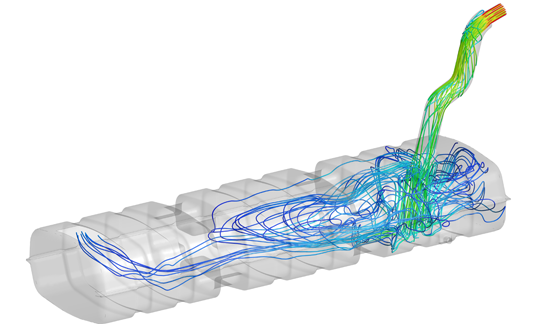
The animation alongside shows the results for the filling of a tank. The simulation was carried out as transient and multiphase (gas phase: air; liquid phase: fuel).
On the basis of the resulting flow field, the following were carried out:
- assessment of whether static charge build-up and foaming occur
- optimisation of the inlet pipe geometry
- optimisation of the venting
- reduction of stirred-up particles by means of baffles in the tank
- reduction of the filling time
Filling of a tank
Have we caught your interest?
Then get in touch and we will get back to you promptly.
