Seismic analysis
A stability verification taking seismic loads into account is required more and more often — including for plant and for mechanical engineering components such as gearboxes or motors.
As part of a seismic verification, a modal analysis is normally carried out first, to determine the natural frequencies and mode shapes of the component under analysis. The results of the modal analysis usually form the basis for choosing the type of analysis for the seismic assessment.
Depending on the geometry, the natural frequency and the requirements, the analysis can be carried out as follows:
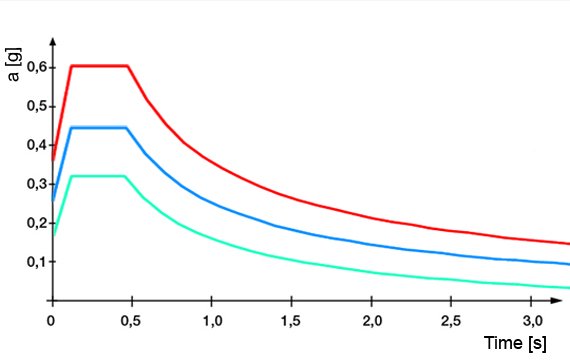
- Quasi-static response spectrum analysis: for sufficiently stiff components, the seismic load can be applied as a static acceleration. The plateau value of the spectrum is usually used. The method is also suitable for a first assessment of the stability of complex components.
- Response spectrum analysis: for components with natural frequencies in the frequency range of the excitation spectrum, a response spectrum analysis is required. A seismic spectrum is defined and combined with the results of the modal analysis. The results are stresses and reaction forces across all frequencies.
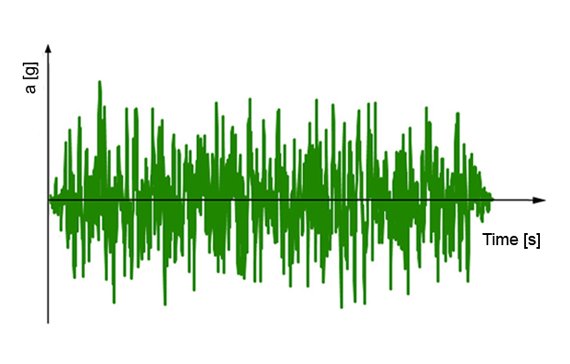
- Time-transient analysis: analyses in the frequency domain (modal and response spectrum analysis) require a linear model. Nonlinearities such as plasticity, contact or friction cannot be represented mathematically. If these are to be taken into account, time-transient acceleration signals — derived from the seismic spectrum or measured — are applied to the component. This analysis is very demanding and is therefore rarely used.
Based on the analyses, the following verifications can be provided:
- Stability verification: the primary purpose of this verification is to ensure that, in the event of an earthquake, the component and its fixing bolts do not fracture, slip or topple, and that no lives are therefore endangered. Significant plastic deformation is permissible; continued operation of the component after the earthquake need not be assured.
- Operability verification: here it must be demonstrated that the component retains its full function during and after an earthquake. This ensures, for example, that rotating components such as a pump impeller do not rub against the casing in a seismic event, and that no impermissibly high stresses arise as a result of the seismic acceleration.
We apply the common European and American codes for determining seismic loads and load case combinations, for example:
- EN 1998 (Eurocode)
- UBC
- IBC
- ASCE 7
- KTA
We carry out the stability verification to the corresponding national, component-specific codes, for example:
- EN 1993 (steel structures)
- EN 13445, AD 2000 or ASME (pressure vessels)
- AISC (steel structures, USA)
- KTA (nuclear technology)
If the verification has to be carried out to a country-specific code — SNiP for Russia, for example — we are happy to work out the procedure for you and provide the verification by analysis.
We have prepared a checklist for seismic analysis for you, which captures the data required for a seismic assessment. It helps you gather the information from your own customer and enables fast, efficient project handling. You are welcome to send the completed checklist along with your enquiry, or at the latest when placing the order.
Have we caught your interest?
Then get in touch and we will get back to you promptly.
