Weld analysis
Many components are made up of welded parts. It must be demonstrated by analysis that these welds are adequately sized to withstand the loads occurring in service. If the component is not only statically loaded in service, a fatigue verification is also required.
Welds can be represented in the analysis model in various ways, depending on the evaluation methodology to be applied:
- accounting for them via a reduction factor
- simplified geometric modelling
- detailed modelling of the welds, with submodels where appropriate
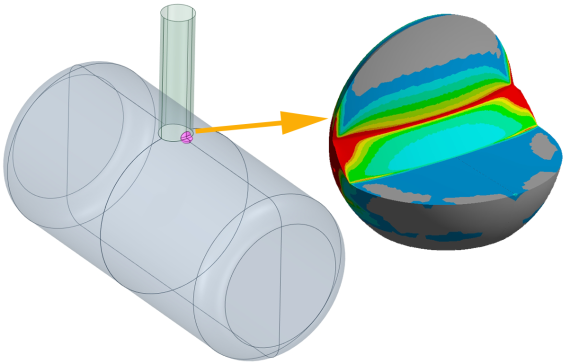
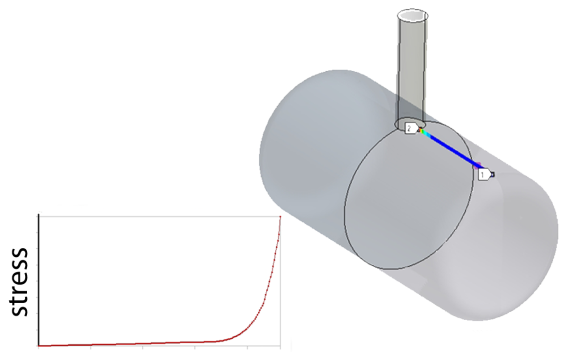
Welds can be assessed in various ways, for example:
- determining nominal stresses from section forces for assessment against weld classes
- extrapolation of the FEA results and assessment against weld classes
- assessment on the basis of local stresses, e.g. the R1 concept
- software-supported assessment, e.g. with FEMFAT Weld or Altair WCD
Beyond this, the question of heat development is often of interest, for example for:
- thermal transient distortion, e.g. maintaining a visible gap
- temperature at sensitive elements, e.g. seals
The following effects can be taken into account in the finite element analysis:
- welding speed
- energy input
- preheating
- hold and cooling times
- single-pass or multi-pass welding
- convection, conduction, radiation
Simulation of component heating during multi-pass welding
Have we caught your interest?
Then get in touch and we will get back to you promptly.
